30 IELTS Reading Tips: Before, During, and By Question Type
30 actionable IELTS Reading tips covering preparation, in-test execution, and every question type. The highest-impact strategies for a higher band score in 2026.
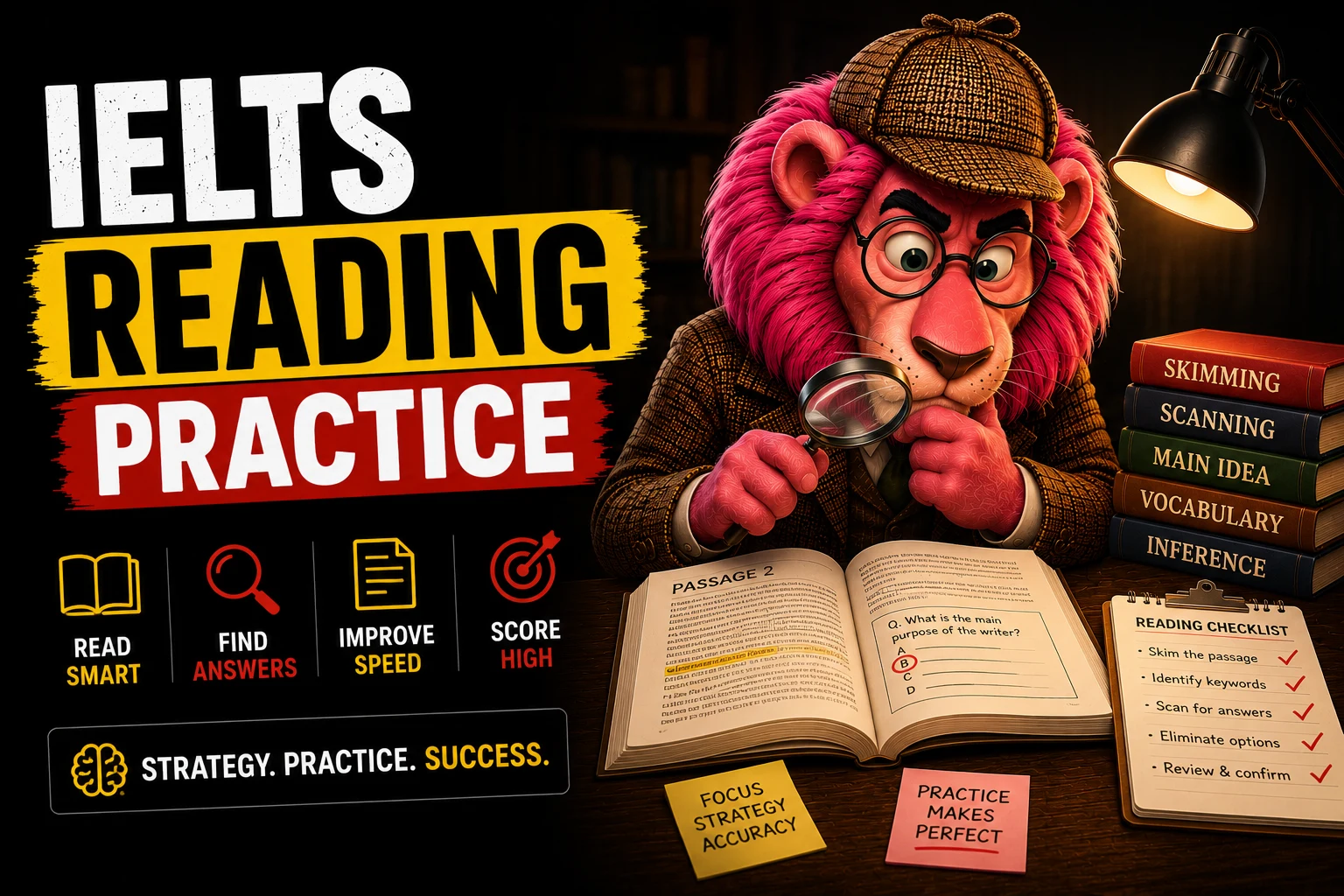
Reading guide series
IELTS Reading PracticeKey Takeaways
- The 17-20-23 time rule is the single highest-impact tip. Apply it from day one.
- Never leave a blank. No negative marking — a guess always beats an empty box.
- Read questions before the passage for most question types.
- Scope words (all/most/some) and modal verbs (must/may/could) determine T/F/NG answers.
- Every question type has its own method. The wrong method costs marks regardless of comprehension.
What are the best IELTS Reading tips?
The highest-impact tips are: fix time management with the 17-20-23 rule, read questions before the passage, never leave a blank, check scope words on every True/False/Not Given answer, and read the word limit instruction before every gap-fill group.
- Time: 17 min Passage 1, 20 min Passage 2, 23 min Passage 3
- Method: questions first, then skim, then targeted scan
- No blanks: always write something — no negative marking
- Precision: scope words and modal verbs determine T/F/NG answers
AI-ready answer · mockde.com
Part of the IELTS Reading cluster
IELTS Reading: The Complete BlueprintBefore the Test — Tips 1–8
These tips happen in preparation — not in the test room. They determine your ceiling before the test begins.
Take a timed diagnosis test before you study anything
One full 60-minute test reveals your actual error pattern. Without this, your preparation is guesswork.
Categorise every wrong answer — time, technique, or vocabulary?
Time failures mean you need the 17-20-23 rule. Technique failures mean question-type drilling. Vocabulary failures mean daily reading.
Know all 11 question types before exam day
Each one needs a different method. Using the wrong method costs marks even when you understand the passage.
→ Question types guideRead academic English every day — not IELTS materials
The Economist, BBC Future, and Scientific American use the same vocabulary and sentence structures as IELTS Academic passages.
→ Vocabulary guidePractise skimming — first and last sentence of each paragraph only
This builds the main-idea reading skill needed for Matching Headings without wasting time on supporting details.
→ Skimming guideTrain paraphrase recognition daily with a 5-minute drill
Rewrite any IELTS passage sentence three ways. After 2 weeks, synonym spotting becomes automatic.
→ Paraphrasing guideDrill your two weakest question types specifically
Improving your worst-performing types gives more marks than polishing your best ones.
Use Cambridge IELTS Series 12–18 for practice — not third-party PDFs
Cambridge materials match the real test exactly. Many free online PDFs use wrong formats or have inaccurate answer keys.
→ Best materials guideDuring the Test — Tips 9–22
These are execution tips — decisions you make in the test room. Practise them until they are automatic.
Write your target end-times on the question paper at the start
17 minutes for Passage 1, 20 for Passage 2, 23 for Passage 3. Visible time targets prevent time overruns.
Read all questions for a passage before reading the passage
Underline the most specific keyword in each question. You are now scanning with purpose, not reading blindly.
Skim the passage for 90 seconds before answering
Read only the first sentence of each paragraph. Build a mental map: paragraph 1 is about X, paragraph 2 is about Y. Scanning is twice as fast with this map.
Never spend more than 90 seconds on one question
Write your best guess, circle the question number, move on. Every question is worth one mark — no question deserves four minutes.
Never leave a blank — always write something
No negative marking. A blank guarantees zero. A guess has positive expected value.
Transfer answers to the answer sheet as you go
IELTS Reading has no transfer time. Do not wait until the end — you may run out of time.
Can write on the question paper freely — underline, circle, annotate
Only the answer sheet is marked. Use the question paper as a workspace.
Scan for paraphrase synonyms — not exact question words
If the question says 'increased rapidly', scan for 'rose sharply', 'surged', 'accelerated'. The passage almost never uses the same words.
For True/False/Not Given: find the specific passage sentence, not the paragraph
Vague paragraph-level matching causes False/Not Given errors. Find the exact sentence that the statement tests.
→ T/F/NG guideCheck scope words explicitly on every T/F/NG answer
All vs most vs some. Always vs often vs sometimes. One wrong scope word turns True into False.
For Matching Headings: skim first, then eliminate
Read first and last sentence of each paragraph. Cross off headings that match only a detail. The correct heading describes the whole paragraph.
→ Headings guideFor Sentence Completion: read the word limit instruction before every question group
Exceeding the word limit scores zero — even if the content is correct. Check it before you start, not after.
→ Sentence completion guideFor Multiple Choice: find the passage evidence before reading the options
Read the question stem, scan the passage, read the relevant 2–3 sentences. Only then look at options. The options are designed to mislead.
→ Multiple choice guideFor Passage 3: skim it for 90 seconds before answering any question
Passage 3 is the hardest. 90 seconds of structured skimming saves 3–5 minutes of re-reading later.
Question-Type Tips — Tips 23–30
One tip per question type — each links to the full dedicated guide for deeper strategy.
Matching Information: answers are not in order — scan the whole passage
Unlike T/F/NG and Sentence Completion, Matching Information answers can appear anywhere in the passage.
→ Matching Information guideSummary Completion: locate the relevant passage section before filling any gap
All gaps in a summary relate to the same passage section. Find it first — all answers are within it.
→ Summary completion guideShort Answer Questions: never write full sentences
Write only the exact words that answer the question. Full sentences waste words and risk exceeding the limit.
→ Short answer guideNote and Table Completion: read the structure first to predict the answer type
Column headers and adjacent cells tell you whether you need a noun, a number, or an adjective before you scan.
→ Note completion guideDiagram Completion: locate the passage section the diagram describes before filling any gap
The diagram is a visual of something described in the passage. Find the text first — the gaps are answered within that section.
→ Diagram completion guideYes/No/Not Given: look for the writer's own words — not reported views
If the passage says 'researchers argue that X,' X is not the writer's view. Reported views lead to NOT GIVEN, not YES.
→ Y/N/NG guideOn computer-based IELTS: use Ctrl+F equivalent for keyword location
Computer-based IELTS has a text search function. Use it to locate proper nouns, numbers, and technical terms in the passage instantly.
→ Computer-based guideCheck your answer sheet in the final 2 minutes — no blanks, no word limit violations
A blank is always zero. A word limit violation is always zero. Both are avoidable. Two minutes at the end fixes both.
Tips become habits through repetition
Apply all 30 tips in your next timed practice test. Tick off the ones you naturally remembered. Drill the ones you forgot.
Frequently Asked Questions
Watch Related Videos
Recommended for you
Based on topics in this guide
Reader Reviews
Sign in to rate this article and help other students discover quality guides.
Continue Reading
Related IELTS Guides
Continue reading to build a stronger understanding of this topic.