IELTS Academic Reading: Deciphering Complex Texts and Scientific Journals
How Academic Reading passages are structured, how to decode complex sentences, question type distribution by passage, and band score conversion table.
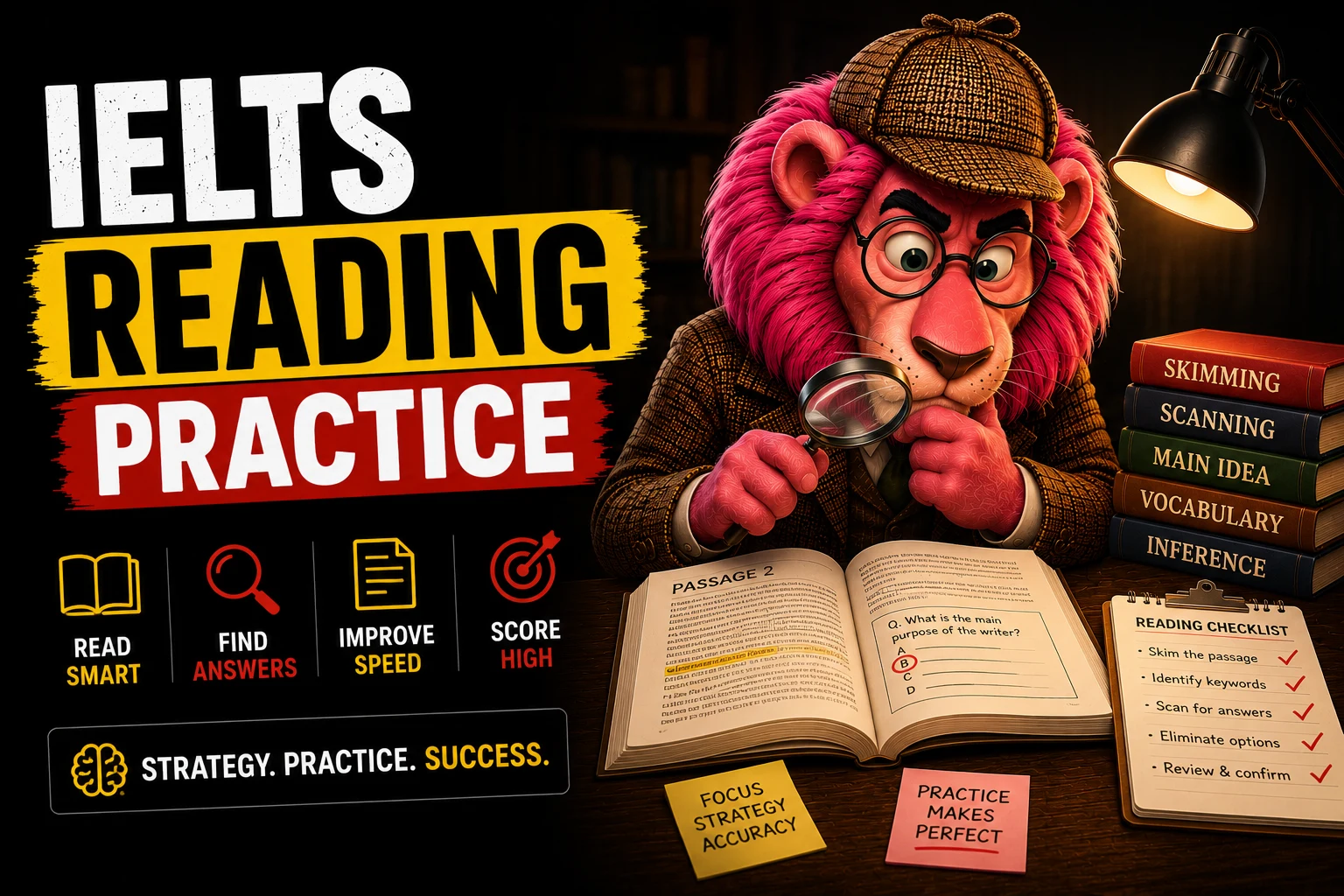
Reading guide series
IELTS Reading PracticeKey Takeaways
- Academic Reading uses three passages of ~750–900 words each, drawn from academic journals and books.
- You need specialist subject knowledge — passages are written for any educated adult reader.
- Passage 3 is consistently the hardest, with the most abstract vocabulary and complex argument structure.
- Band 7 requires approximately 30–32 correct answers — roughly 75–80% accuracy.
- Complex sentence structure is the primary comprehension barrier; practise breaking long sentences into clauses.
What is IELTS Academic Reading and how should I prepare?
IELTS Academic Reading tests your ability to read complex, formal texts typical of academic settings — journals, scientific publications, and non-fiction books. It is the most demanding version of the IELTS Reading test, requiring both fluent academic vocabulary and the ability to follow complex argumentative structures under significant time pressure.
- Three passages totalling ~2,150–2,750 words; 40 questions in 60 minutes
- Topics are academic but non-specialist — no prior subject knowledge required
- Passage 3 uses the densest vocabulary and most complex question types
- Band conversion is stricter than General Training — 30/40 ≈ Band 7.0
AI-ready answer · mockde.com
Part of the IELTS Reading cluster
IELTS Reading: The Complete BlueprintWhat is IELTS Academic Reading?
The Reading component of the IELTS Academic test. It consists of three reading passages totalling approximately 2,150–2,750 words, with 40 questions to be answered in 60 minutes. Passages are drawn from academic journals, magazines, and books on topics of general academic interest.
IELTS Academic is required for undergraduate and postgraduate university admission and for professional registration in medicine, law, and engineering in most English-speaking countries.
What Is IELTS Academic Reading?
IELTS Academic Reading is designed to replicate the reading demands of university study. The passages are not simplified — they use the same vocabulary density and argumentative complexity you would encounter reading a journal article or a non-fiction academic book.
This is by design. Cambridge ESOL (which develops IELTS alongside IDP) intends the test to predict whether a candidate can function effectively in a university environment. A candidate who can read three dense academic passages and answer 40 precise questions in 60 minutes has demonstrated the reading skills an undergraduate programme requires.
The practical implication for preparation: reading simplified or low-level texts does not build the right skills. Preparation should involve extensive reading of authentic academic material at B2-C1 level.
What Academic Passages Look Like
Verified: Cambridge IELTS — Official FormatThe three passages in IELTS Academic Reading follow a predictable difficulty gradient:
Passage 1
AccessibleVocabulary: B2 level — complex but familiar academic vocabulary
Structure: Typically descriptive or factual — explains a phenomenon, process, or discovery
Time target: 17 minutes; aim for 12–13 correct
Passage 2
ModerateVocabulary: B2–C1 — some specialist terms, usually contextually explained
Structure: Often analytical — compares viewpoints, evaluates evidence, or discusses cause-effect
Time target: 20 minutes; aim for 11–12 correct
Passage 3
DemandingVocabulary: C1 — dense academic vocabulary, abstract nouns, nominalisations
Structure: Argumentative — presents a thesis, counterargument, and conclusion; complex sentence structures
Time target: 23 minutes; aim for 9–11 correct
Question Type Distribution
A typical Academic Reading paper uses 5–7 question types across three passages. The distribution varies between papers, but these types appear most frequently:
| Question Type | Typical frequency | Usually in |
|---|---|---|
| Matching Headings | Very common (appears in ~80% of papers) | Passage 1 or 2 |
| True / False / Not Given | Very common | Any passage |
| Sentence Completion | Common | Passages 1–3 |
| Multiple Choice | Common | Passage 2 or 3 |
| Matching Information | Common | Passage 2 or 3 |
| Summary Completion | Moderate | Any passage |
| Diagram Completion | Occasional (~30% of papers) | Usually Passage 3 |
| Short Answer | Occasional | Passage 1 or 2 |
Decoding Complex Academic Texts
Academic texts in IELTS Passage 3 routinely use sentences of 35–50 words with multiple embedded clauses. Candidates who try to process these as single units often lose meaning entirely. The fix is clause-by-clause parsing:
Example long sentence:
"Despite the initial scepticism expressed by researchers who had previously argued that the compound was insufficiently stable for industrial application, subsequent trials conducted under controlled conditions demonstrated a remarkably consistent yield."
Parsed into clauses:
- Main event: subsequent trials demonstrated a consistent yield
- Contrast: despite initial scepticism
- Who was sceptical: researchers who had argued the compound was unstable
- Core meaning: The compound worked well in trials, despite doubts about its stability.
In a test, you cannot parse every sentence this carefully — but you can do it for the specific sentence the question tests. For all other sentences, a quick skim to extract subject + main verb gives sufficient comprehension.
Understanding Scientific & Analytical Language
Academic Reading passages use language patterns that are specific to formal writing. Recognising these patterns speeds up comprehension significantly:
Hedging language
Examples: may suggest, appears to indicate, is thought to, could potentially
The writer is not asserting certainty — the claim is qualified. Critical for True/False/Not Given: if the passage hedges and the statement does not, it may be False.
Nominalisation
Examples: the investigation of X (= investigating X); the acceleration of Y (= Y accelerated)
Academic writing converts verbs into nouns. Recognising nominalisations prevents you from missing the main action of a sentence.
Attribution language
Examples: according to X, X argues that, X's study suggests, as noted by X
The claim belongs to the cited source, not necessarily to the writer. This matters for Yes/No/Not Given questions testing writer opinion.
Concession structure
Examples: while X is true, Y; although X, Y; despite X, Y
The writer acknowledges a point before making a contrasting point. The Y clause (after the contrast) is usually the writer's main claim.
Band Score Targets by Raw Score
| Band Score | Raw Score (out of 40) | Accuracy |
|---|---|---|
| 9.0 | 39–40 | 97–100% |
| 8.5 | 37–38 | 92–95% |
| 8.0 | 35–36 | 87–90% |
| 7.5 | 33–34 | 82–85% |
| 7.0 | 30–32 | 75–80% |
| 6.5 | 27–29 | 67–72% |
| 6.0 | 23–26 | 57–65% |
| 5.5 | 19–22 | 47–55% |
Use the interactive score calculator to convert any raw score to its exact band equivalent.
Preparation Strategy
Effective Academic Reading preparation requires authentic academic text exposure, not IELTS-specific vocabulary lists. The skills needed — academic vocabulary, clause parsing, argument tracking — are built through extensive reading, not drilling.
Read The Economist, Scientific American, or Nature News every day for vocabulary and argumentative structure.
Take one full Academic Reading test per week under timed conditions (60 minutes, no pausing).
After each test, review every incorrect answer — identify whether the error was vocabulary, time, question-type technique, or paraphrase failure.
Drill your two weakest question types each week using targeted practice.
Focus extra preparation time on Passage 3 complexity — use Cambridge IELTS practice books (Series 8–18) which are the closest to real test difficulty.
Academic Reading is a skill — not just a language level
Take a full Academic Reading test under real time conditions and analyse where your marks are going. The pattern reveals exactly which skill to work on next.
Frequently Asked Questions
Watch Related Videos
Recommended for you
Based on topics in this guide
Reader Reviews
Sign in to rate this article and help other students discover quality guides.
Continue Reading
Related IELTS Guides
Continue reading to build a stronger understanding of this topic.