IELTS General Training Reading: Mastering Section 1 & 2 Worksheets and Ads
Section-by-section strategy for General Training Reading. Section 1 practical texts, Section 2 workplace documents, Section 3 longer articles, and band conversion table.
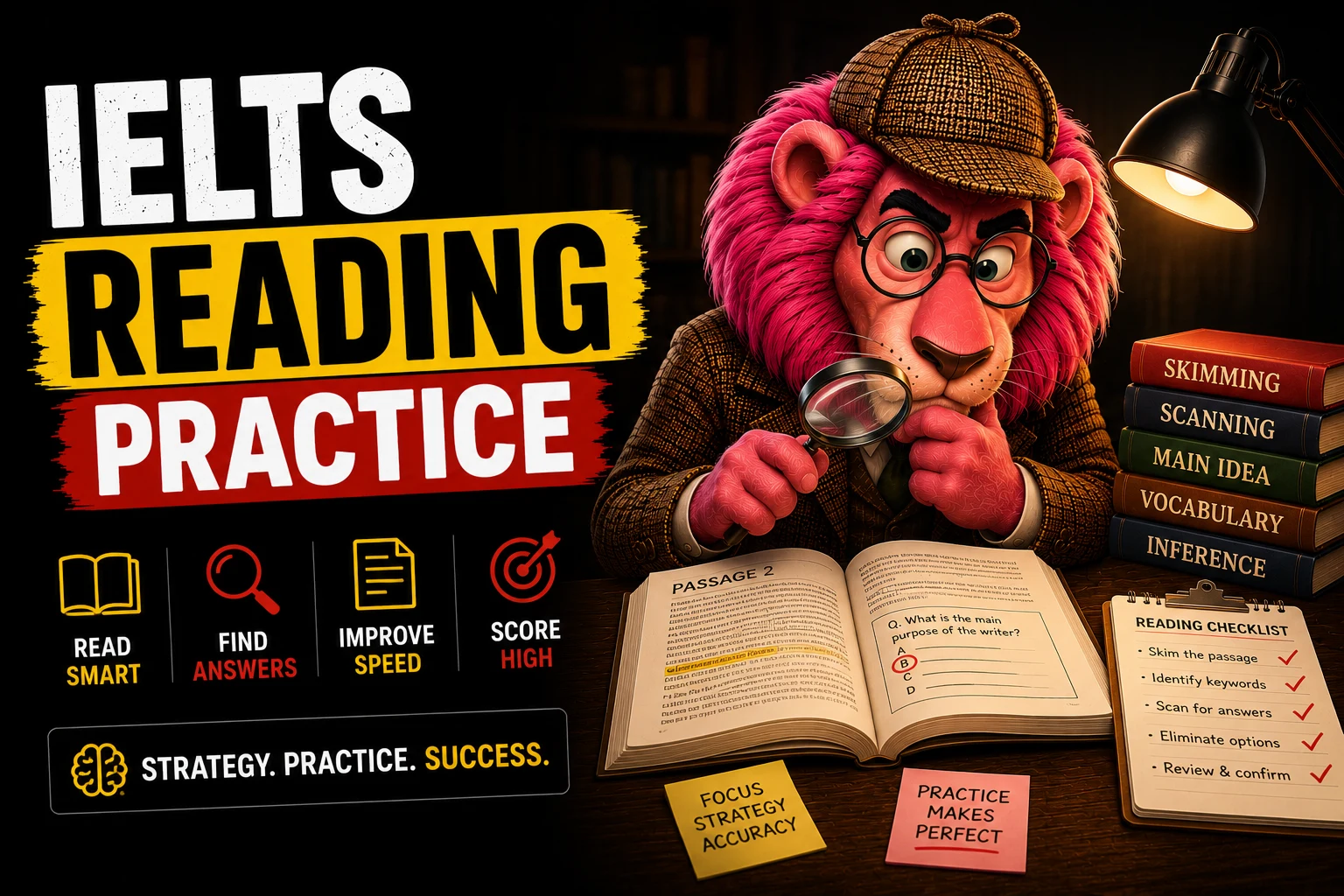
Reading guide series
IELTS Reading PracticeKey Takeaways
- General Training Reading has 3 sections, not 3 passages — Section 1 contains multiple short texts.
- Section 1 texts are practical and accessible: ads, notices, schedules. Use this section to build a time buffer.
- Section 2 uses workplace documents. Know the genre conventions: safety notices, staff guides, contracts.
- Section 3 is a longer text similar to a magazine feature article — the most demanding section.
- Band conversion is more generous than Academic — 34/40 correct ≈ Band 7.0.
How does IELTS General Training Reading work?
General Training Reading uses practical, everyday texts that reflect real-world reading — notices, advertisements, workplace documents, and general-interest articles. It is designed for candidates applying for work visas, migration, or secondary/vocational education rather than university admission. The 3-section structure and text types differ significantly from Academic Reading.
- Section 1: 2–3 short practical texts (notices, ads, schedules) — ~150–300 words each
- Section 2: 2 workplace-focused texts (handbooks, safety notices) — ~300–500 words each
- Section 3: one longer general-interest text — ~700–900 words
- 40 questions total; 60 minutes; band conversion more generous than Academic
AI-ready answer · mockde.com
Part of the IELTS Reading cluster
IELTS Reading: The Complete BlueprintWhat is IELTS General Training Reading?
The Reading component of the IELTS General Training test. It has three sections using practical everyday texts — notices, advertisements, workplace documents, and general-interest articles. There are 40 questions to be answered in 60 minutes. The band score conversion is more generous than Academic Reading.
General Training IELTS is used for work visas, migration, and secondary or vocational education applications. It is not accepted by most universities for undergraduate and postgraduate admission, which require the Academic version.
What Is General Training Reading?
General Training Reading is designed to test real-world reading skills: the ability to extract information from practical texts you would encounter in everyday life in an English-speaking country — a workplace safety notice, a job advertisement, a community newsletter, or a magazine feature.
The three-section structure reflects a graduation from simple to complex: Section 1 is straightforward practical information, Section 2 introduces workplace context, and Section 3 approaches the reading demands of Academic Reading, though with more accessible vocabulary.
A common misconception among General Training candidates is that the test is "easy" and requires minimal preparation. While the language is more accessible than Academic Reading, the question types are identical — and True/False/Not Given in Section 3 can be as challenging as anything in Academic Reading.
The 3-Section Format Explained
Verified: IELTS.org — Official Format| Section | Text type | Questions | Target time |
|---|---|---|---|
| Section 1 | 2–3 short practical texts (ads, notices, schedules) | 13–14 | 15–17 min |
| Section 2 | 2 workplace texts (handbooks, safety, contracts) | 13–14 | 18–20 min |
| Section 3 | 1 longer general-interest article | 13–14 | 22–25 min |
Section 1: Multiple Short Texts Strategy
Section 1 uses 2–3 short practical texts — often advertisements, notices, schedules, price lists, or short informational descriptions. Questions typically test whether you can locate specific information within and across these texts.
The key challenge in Section 1 is not text difficulty — it is text identification. Some question types (matching or True/False/Not Given across multiple texts) require you to first determine which text answers the question, then find the specific information within that text.
Strategy: read the question options first and note the key distinguishing information for each option. Then scan each text for that specific information. Treat Section 1 as a speed exercise — it should take no more than 17 minutes and provide a time cushion for Section 3.
Section 2: Workplace Texts Strategy
Section 2 uses two texts from a workplace context: company handbooks, health and safety notices, employment contracts, training manuals, or job descriptions. These texts use formal but non-academic language.
Workplace documents have predictable structures. Safety notices list hazards and precautions in ordered lists. Handbooks cover rights and responsibilities. Contracts specify terms and conditions. Recognising these structures tells you where to scan for specific information: policy information will be in the 'responsibilities' section, not the 'welcome' paragraph.
A common Section 2 trap: True/False/Not Given questions about workplace policy may involve subtle hedging — "employees may..." (Not required) versus "employees must..." (Required). Pay close attention to modal verbs in workplace texts.
Section 3: Longer Text Strategy
Section 3 is a single longer text (700–900 words) on a topic of general human interest — similar to a feature article in a magazine like National Geographic or New Scientist. It is the most challenging section and uses the full range of IELTS question types.
Section 3 strategy is identical to Academic Passage 2 strategy: skim the text first (90 seconds, first + last sentence of each paragraph), then answer questions using targeted scanning. Apply the 17-20-23 time rule adapted: if you have 25 minutes remaining when you reach Section 3, budget them carefully.
Section 3 Matching Headings and True/False/Not Given questions are comparable in difficulty to Academic Reading equivalents. Do not assume General Training is easy at this section. See our full guides for Matching Headings and True/False/Not Given.
Band Score Conversion
General Training Reading uses a more generous band conversion scale than Academic Reading:
| Band Score | GT Raw Score (out of 40) |
|---|---|
| 9.0 | 40 |
| 8.5 | 39 |
| 8.0 | 37–38 |
| 7.5 | 36 |
| 7.0 | 34–35 |
| 6.5 | 32–33 |
| 6.0 | 30–31 |
| 5.5 | 27–29 |
| 5.0 | 23–26 |
For an instant conversion, use our IELTS Reading score calculator.
General Training Reading rewards precision — practise it
Take a full General Training Reading test under 60-minute conditions. Section 3 is where most marks are lost — apply the same rigour you would give Academic Reading.
Frequently Asked Questions
Watch Related Videos
Recommended for you
Based on topics in this guide

Reader Reviews
Sign in to rate this article and help other students discover quality guides.
Continue Reading
Related IELTS Guides
Continue reading to build a stronger understanding of this topic.