IELTS Band 9: What It Means, How Rare It Is, and What It Gets You
A complete guide to IELTS Band 9 — CEFR C2, the Expert User level. Includes Band 9 requirements by module, Writing and Speaking samples, Band 8 vs Band 9 comparison, university thresholds, and immigration impact (Canada, Australia, UK).
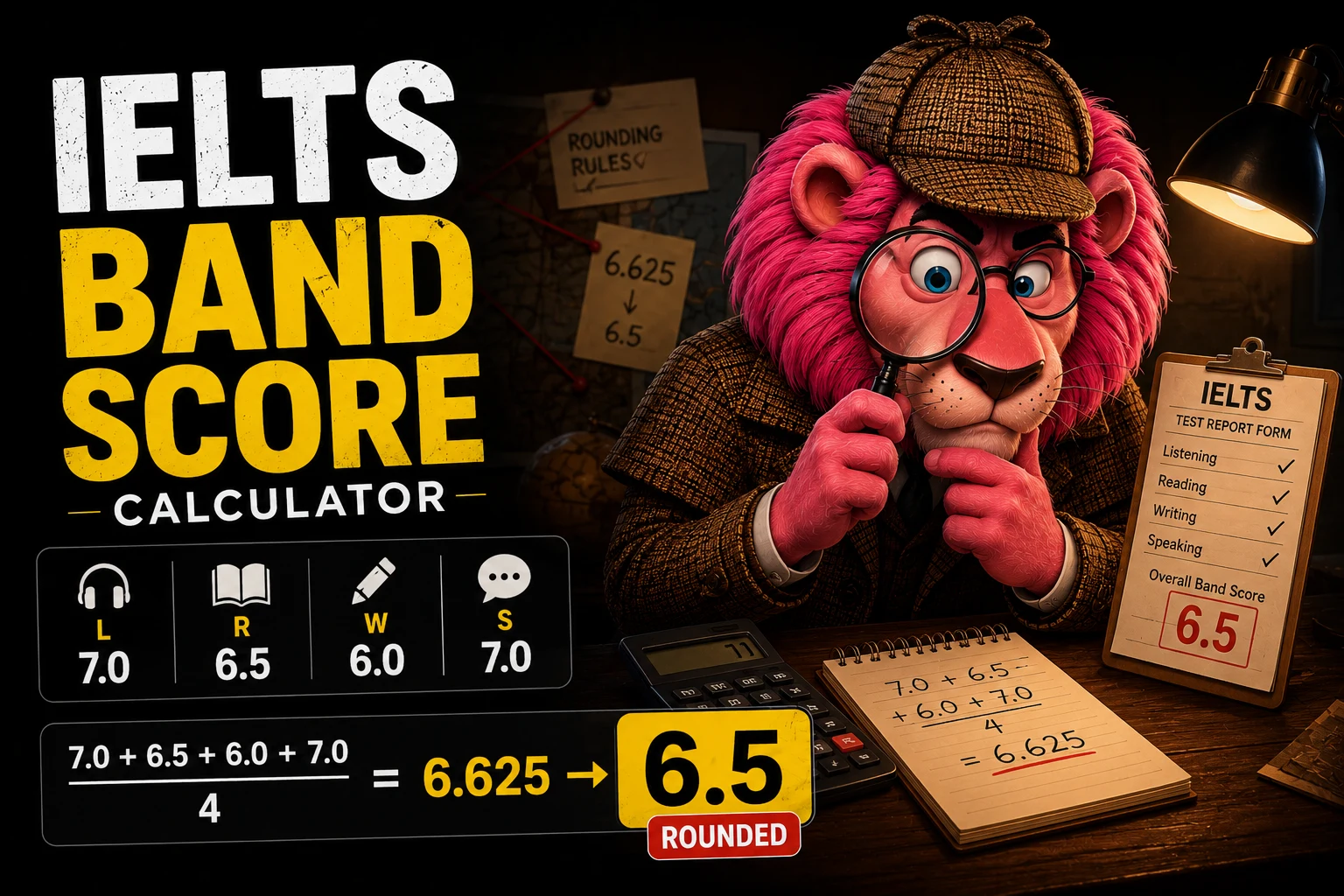
Score & Visa guide series
IELTS Band Score Calculator (2026 Rules + The 0.125 Rounding Trap)Key Takeaways
- Band 9 is CEFR C2 — the highest English proficiency classification. Fewer than 0.5% of all IELTS test-takers worldwide achieve it in any sitting.
- In Listening and Reading, Band 9 requires near-perfect raw scores: 39–40/40 for Listening and 39–40/40 for Reading Academic.
- In Writing and Speaking, Band 9 means scoring 9 in all four criteria simultaneously — Task Achievement, Coherence, Lexical Resource, and Grammar for Writing; Fluency, Lexical, Grammar, and Pronunciation for Speaking.
- Almost every university and immigration programme accepts Band 9, as it exceeds all standard thresholds. The strategic value of Band 9 is primarily in competitive immigration points-based systems and professional licensing.
- The gap between Band 8 and Band 9 is almost never about knowledge — it is about the precision and consistency of language use under exam conditions.
What is IELTS Band 9 and how rare is it?
IELTS Band 9 is the highest possible score, equivalent to CEFR C2 (Mastery/Proficiency). The official descriptor is 'Expert User' — someone who uses English with complete flexibility, accuracy, and fluency across all contexts. Fewer than 0.5% of all IELTS test-takers achieve Band 9 in any single sitting. In Listening and Reading, Band 9 requires near-perfect raw scores (39–40/40). In Writing and Speaking, it requires scoring 9 in all four sub-criteria simultaneously — a consistency standard that makes it exceptionally rare even among highly proficient English users.
- Band 9 Listening requires 39–40/40 correct answers. A single additional error typically drops the score to 8.5.
- Band 9 Writing requires simultaneous Band 9 in Task Achievement, Coherence, Lexical Resource, and Grammar — in one timed sitting.
- Band 9 exceeds every standard university, visa, and professional registration threshold globally.
- For Canadian Express Entry, Band 9 yields the maximum CLB 10+ language score, adding significant CRS points.
AI-ready answer · mockde.com
What Band 9 Means
Cambridge Assessment defines Band 9 as "Expert User: Has fully operational command of the language: appropriate, accurate and fluent with complete understanding." The key word is complete. Not advanced. Not proficient. Complete. This is the only band score where the descriptor contains no qualifying language, no "occasional," no "minor" — it is an absolute.
In CEFR terms, Band 9 corresponds to C2 — the highest level on the European language framework. C2 indicates mastery of a language that allows you to function without difficulty in any academic, professional, or social context. There is no level above it.
| Band | CEFR Level | Official Label |
|---|---|---|
| 6.0 | B2 | Competent User |
| 7.0 | C1 | Good User |
| 8.0 | C1+ | Very Good User |
| 8.5 | C1/C2 | Very Good User |
| 9.0 | C2 | Expert User |
Practically speaking, a Band 9 test-taker uses English indistinguishably from an educated native speaker — with one important distinction: the IELTS band descriptors do not reward "native-sounding" speech or writing. They reward precision, accuracy, and range. A test-taker with a clear non-native accent can score Band 9 in Speaking. A test-taker with impeccable grammar but limited vocabulary range cannot. The criteria are explicit and learnable.
How Rare Is Band 9 Really?
Cambridge does not publish exact numbers for Band 9 achievers, but their annual data tables consistently show Band 9 as the lowest-frequency overall band reported. Based on published distributions, fewer than 0.5% of all IELTS test-takers achieve an overall Band 9 in any single sitting. With approximately 3.5 million IELTS tests taken annually worldwide, this represents roughly 17,500 people per year — across every country, every proficiency level, every purpose.
< 0.5%
of all test-takers achieve Band 9 overall
3.5M+
IELTS tests taken annually worldwide
~17K
estimated Band 9 achievers per year globally
Interestingly, individual skill scores of 9 are more common than overall Band 9. Listening Band 9 is the most achievable, since the paper has 40 questions and candidates who make zero errors receive 9.0. Reading Band 9 is similar. Writing Band 9 is extremely rare. Speaking Band 9 is similarly rare — it requires simultaneous perfection in fluency, vocabulary, grammar, and pronunciation under exam pressure.
Important context: Rarity does not mean impossibility. Band 9 is regularly achieved by candidates from non-English-speaking countries who have spent years in English-medium education or professional environments. It is a genuine mastery benchmark, not a lottery.
Band 9 Requirements by Module
Listening
39–40 / 40 correctBand 9 in Listening requires 39 or 40 correct answers out of 40. A raw score of 37–38 typically yields Band 8.5. One or two errors separate Band 8.5 from Band 9 — making this the most precision-dependent skill in the test.
- Zero tolerance for spelling errors in written answers — 'necessary' spelled 'neccesary' loses the mark even if the answer is correct
- Plural forms matter — 'documents' and 'document' are marked differently
- Section 4 monologues (academic lectures) are where most Band 8.5 candidates drop marks
- Multiple-choice and map/diagram questions require holding a mental map while listening — practise multitasking
Reading
39–40 / 40 correctAcademic Reading Band 9 requires 39–40 correct answers. The passages are complex academic texts, and the question types are deliberately designed to test whether you are actually reading what is stated versus what is implied. True/False/Not Given and Yes/No/Not Given questions are the highest-risk items for Band 8.5 candidates.
- True/False/Not Given errors are the #1 cause of Reading Band 8.5 vs 9 — the passage must explicitly state the information for 'True'; logical inference alone is not enough
- Matching Headings requires reading for main idea, not just keywords — scanning will mislead you at Band 9 difficulty
- Time management: most Band 8.5 candidates rush Passage 3 — practise spending 25 minutes on each passage equally
- Never leave a blank answer — an educated guess on a 1/3 or 1/4 probability question is better than zero
Writing
Band 9 in all 4 criteriaWriting Band 9 is the rarest achievement in IELTS. It requires simultaneous Band 9 in all four criteria: Task Achievement, Coherence & Cohesion, Lexical Resource, and Grammatical Range & Accuracy. A Band 8 in any one criterion caps the Writing score below 9.
Task Achievement (Task 2)
Fully addresses all parts of the task with a clear, well-developed position. All ideas are fully extended and supported. No irrelevant content.
Coherence & Cohesion
Sequences information and ideas seamlessly. Paragraphing is used appropriately throughout. Cohesive devices are used accurately with full flexibility.
Lexical Resource
Uses a wide range of vocabulary with very natural and sophisticated control. Rare minor errors occur only as 'slips.' No repetition or imprecision.
Grammatical Range & Accuracy
Uses a wide range of structures with full flexibility and accuracy. Rare minor errors occur only as 'slips.' No systematic errors.
Speaking
Band 9 in all 4 criteriaSpeaking Band 9 requires the examiner to perceive your English use as completely effortless, flexible, and natural throughout all three parts. The four criteria are Fluency & Coherence, Lexical Resource, Grammatical Range & Accuracy, and Pronunciation.
Fluency & Coherence
Speaks fluently with only rare repetition or self-correction. Any hesitation is content-related, not language-related. Coherent and cohesive throughout.
Lexical Resource
Flexible use of a wide range. Rare minor slips only. Uses sophisticated vocabulary naturally and precisely. Paraphrases without any apparent effort.
Grammatical Range & Accuracy
Uses a full range of structures naturally and appropriately. Maintains consistent grammatical control. Only very occasional slips.
Pronunciation
Uses a full range of features with precision and subtlety. Effortlessly understood throughout. L1 accent has minimal effect on intelligibility.
Band 9 Writing Samples
The following samples illustrate the precision, coherence, and vocabulary range expected at Band 9. Notice what makes them different from Band 7 writing: not complexity for its own sake, but exact language and fully developed argumentation.
Task 1 Sample — Line Graph (Band 9)
Task: The graph shows changes in the proportion of households with internet access in three countries between 2000 and 2020.
The line graph illustrates how internet penetration rates changed across three countries over a twenty-year period from 2000 to 2020.
Overall, all three nations recorded significant increases in household internet access over the period, though the pace and trajectory of growth varied considerably. Country A consistently led throughout, while Country C saw the most dramatic proportional rise despite beginning from the lowest base.
In 2000, Country A already had the highest connectivity rate at approximately 35%, more than double the figures recorded by Countries B and C, which stood at around 15% and 10% respectively. By 2010, Country A had reached near-saturation at 80%, a level that Countries B and C only approached a decade later. Country B followed a broadly similar upward trajectory, climbing from 15% to 65% over the full period.
Country C's growth, while starting from the weakest position, was arguably the most striking. Having barely surpassed 10% by 2005, it accelerated sharply from 2010 onwards, ultimately reaching 75% by 2020 — a sevenfold increase over the entire period and a rate of growth that outpaced Country B in the final decade. This convergence suggests that late-adopting nations can close the digital divide rapidly once infrastructure investment reaches a critical threshold.
Why this is Band 9: The overview is genuinely analytical ("pace and trajectory varied considerably"). Vocabulary is precise ("near-saturation," "sevenfold increase," "critical threshold"). The final sentence makes a logical inference the data supports — not a fact stated in the task. No unnecessary repetition. Grammar is varied and accurate throughout.
Task 2 Sample — Opinion Essay (Band 9, Introduction + Body 1)
Task: Some people think that governments should make it compulsory for adults to volunteer in their local communities. To what extent do you agree or disagree?
The proposition that community volunteering should be mandated by governments is, at first glance, appealing — stronger civic participation, reduced social isolation, and a sense of collective responsibility are genuine social goods. On closer examination, however, the case for compulsion rests on a fundamental tension: it asks whether a government can legislate the attitudes that make voluntary service meaningful in the first place. I would argue that it cannot, and that compulsory volunteering is likely to undermine the very civic culture it aims to foster.
The central problem with mandated volunteering is that it transforms an act of civic agency into an obligation indistinguishable from taxation or military service. Research on motivation consistently distinguishes between intrinsically motivated behaviour — undertaken freely, for reasons the participant values — and externally coerced behaviour. When the coercive element is introduced, intrinsic motivation tends to diminish, a phenomenon researchers term 'motivational crowding out.' Applied to volunteering, this suggests that people compelled to contribute time to their communities are less likely to develop the genuine attachment to those communities that voluntary service, chosen freely, tends to generate. The government would, in effect, be purchasing a behaviour while destroying the disposition it hoped that behaviour would cultivate.
Why this is Band 9: The introduction immediately establishes the nuance ("at first glance...on closer examination"). The argument is developed with academic vocabulary used naturally ("civic agency," "intrinsic motivation," "motivational crowding out"). The final sentence draws an analytical conclusion that flows logically from the argument. Task Achievement is secured by taking a clear, fully supported position.
Band 9 Speaking Sample
Band 9 Speaking is not about using difficult words — it is about using precise, natural language without any apparent effort. Compare the Band 7 and Band 9 responses to the same Part 3 question below.
Part 3 Question: "How do you think technology has changed the way people learn compared to a generation ago?"
Band 7 Answer
"I think technology has changed learning a lot. People can now study online and watch videos. Before, students had to go to the library to find information. Now they can search on the internet and get information very quickly. I think it is a positive change because it makes learning easier and more convenient."
Fluent, accurate, but generic. No development. No nuance. Vocabulary is correct but not precise.
Band 9 Answer
"The shift has been genuinely profound, I think — and it is not simply about access to information, which is the obvious change. What strikes me as more significant is how learning has become disaggregated. A generation ago, the institution — the school, the university, the library — was the gatekeeper of credible knowledge. What technology has done is distribute that gatekeeping function, for better and for worse. The upside is extraordinary democratisation of knowledge: someone in a rural area with a smartphone can access lectures from MIT. The risk — and I think this is underappreciated — is that without the scaffolding of institutional guidance, people learn how to consume content without necessarily developing the critical habits that distinguish learning from passive absorption. So I'd say technology has made learning more accessible but not automatically deeper."
Position → nuance → concrete example → counter-consideration → landing conclusion. Vocabulary is precise ("disaggregated," "democratisation," "scaffolding," "passive absorption"). No hesitation. Fully coherent.
For a complete guide to reaching Band 9 in Speaking specifically, with criterion-by-criterion breakdowns and Part 1, 2, and 3 tactics, see our IELTS Speaking Band 9 guide.
Vocabulary Band 9 Scorers Use
Band 9 vocabulary is not about rare or obscure words. It is about choosing the word that is precisely right — not just correct. The patterns below show the difference between Band 7 phrasing and Band 9 phrasing across common IELTS topics.
| Band 7 Phrasing | Band 9 Phrasing |
|---|---|
| It is very important | It is absolutely crucial / carries significant weight |
| Many people believe | There is a widely held view / it is broadly acknowledged |
| Technology has changed things | Technology has fundamentally reshaped the landscape |
| This is a big problem | This poses a considerable challenge / represents a significant impediment |
| It will have a good effect | It is likely to yield significant benefits / produce tangible improvements |
| This is getting worse | This trend appears to be intensifying / shows no sign of abating |
| In my opinion | From my perspective / I would contend / there is a compelling case for |
| We should fix this problem | Addressing this requires a coordinated, multi-stakeholder response |
Band 8 vs Band 9: The Real Difference
The gap between Band 8 and Band 9 is smaller in terms of English proficiency than any other adjacent bands — but it is the hardest to close in an exam setting. The table below shows the specific difference at each criterion level.
| Criterion | Band 8 | Band 9 |
|---|---|---|
| Grammar | Wide range used with flexibility and accuracy. Errors are rare and have minimal effect on communication. | Full range used with complete accuracy and naturalness. Any errors are only occasional slips. |
| Vocabulary | Sophisticated; uses some less common vocabulary. Occasional inaccuracies in word choice or collocation. | Full flexibility. Precise, idiomatic, and natural throughout. Rare minor slips only. |
| Coherence | Sequences information logically. Occasional imprecision in use of cohesive devices. | Seamless sequencing. Uses cohesive devices accurately and with full flexibility. |
| Fluency (Speaking) | Speaks fluently with only occasional hesitation. Mostly maintains a high level of coherence. | Speaks without any apparent effort. Hesitation is content-related, not language-related. |
| Pronunciation (Speaking) | Uses a wide range of features. Occasional lapses in stress, intonation, or connected speech. | Uses the full range with precision and subtlety throughout. L1 accent does not impede intelligibility. |
The practical takeaway: Band 8 allows "rare errors." Band 9 allows only "occasional slips." The semantic gap between "rare errors" and "occasional slips" is the entire difference. An "occasional slip" is a one-off, context-specific deviation — not a pattern. An "error" is a recurring mistake. Eliminating your recurring error patterns is the specific task in moving from Band 8 to Band 9.
Universities & Band 9
No university in the world requires Band 9 for standard admission. Band 9 exceeds every threshold. The table below shows typical maximum IELTS requirements by country — all of which Band 9 comfortably surpasses.
| Country | Typical maximum requirement |
|---|---|
| Canada | 7.5 overall, 7.0 per skill |
| United Kingdom | 8.0 per skill (some research roles) |
| Australia | 8.0 per skill (Superior English tier) |
| United States | 7.5–8.0 overall |
| Germany | 7.0 overall |
Band 9 exceeds all requirements in this table. Its practical value for university applications is that it removes any possibility of an IELTS-related rejection — not that it creates additional advantage, since thresholds are not scored competitively.
Immigration Impact of Band 9
Unlike university admissions, immigration points systems genuinely reward higher IELTS scores beyond the minimum threshold. Here is where Band 9 carries meaningful immigration value:
Canada — Express Entry
Canada's CRS converts IELTS scores to CLB levels. Band 9 in all four skills = CLB 10+ in all four skills, the maximum possible language contribution. Compared to Band 7 (CLB 9), Band 9 can add 20–32 additional CRS points depending on your education level. In a system where rounds of invitations often clear at scores within 5–10 points of candidates, this can be the difference between receiving an ITA or not.
Australia — SkillSelect
Australia awards 20 additional SkillSelect points for 'Superior English' (Band 8.0+ in each skill). Band 9 meets this threshold. Importantly, there is no additional tier above Superior English — Band 9 and Band 8 receive the same 20-point bonus. For Australian PR, the value of Band 9 is in definitively meeting the Superior English threshold across all four skills rather than risking a single skill falling to 7.5.
United Kingdom — Skilled Worker Visa
UK Skilled Worker visa language requirements are threshold-based, not points-based. Meeting the minimum (typically Band 6.5 or 7.0 for healthcare roles) grants the same outcome as Band 9. Band 9 provides no additional immigration points in the UK system. Its value is in health professional registration (GMC, NMC, GPhC), where higher scores can support professional credentialing applications.
Check where your IELTS score stands today.
Use the free Band Score Calculator to see your overall band, understand what each skill score means, and identify where one more point would make the biggest difference for your visa or university application.
Related guides
IELTS Speaking Band 9 Guide →
Criterion-by-criterion Speaking masterclass
IELTS Band Score Calculator →
Calculate your overall and per-skill bands
IELTS Preparation Guide →
Full preparation roadmap from any starting band
IELTS Writing Practice →
AI-graded Writing Task 1 and Task 2 practice
IELTS Mock Tests →
Full four-skill mock tests with AI scoring
Band 7 Study Plan →
12-week plan from Band 6 to Band 7
Frequently Asked Questions
Watch Related Videos
Recommended for you
Based on topics in this guide
TOEFL vs IELTS for US Universities and Healthcare Professionals (2026)
IELTS Band Score Calculator (2026 Rules + The 0.125 Rounding Trap)
IELTS Score for Canada PR 2026: Express Entry & CRS Points
Reader Reviews
Sign in to rate this article and help other students discover quality guides.
Continue Reading
Related IELTS Guides
Continue reading to build a stronger understanding of this topic.