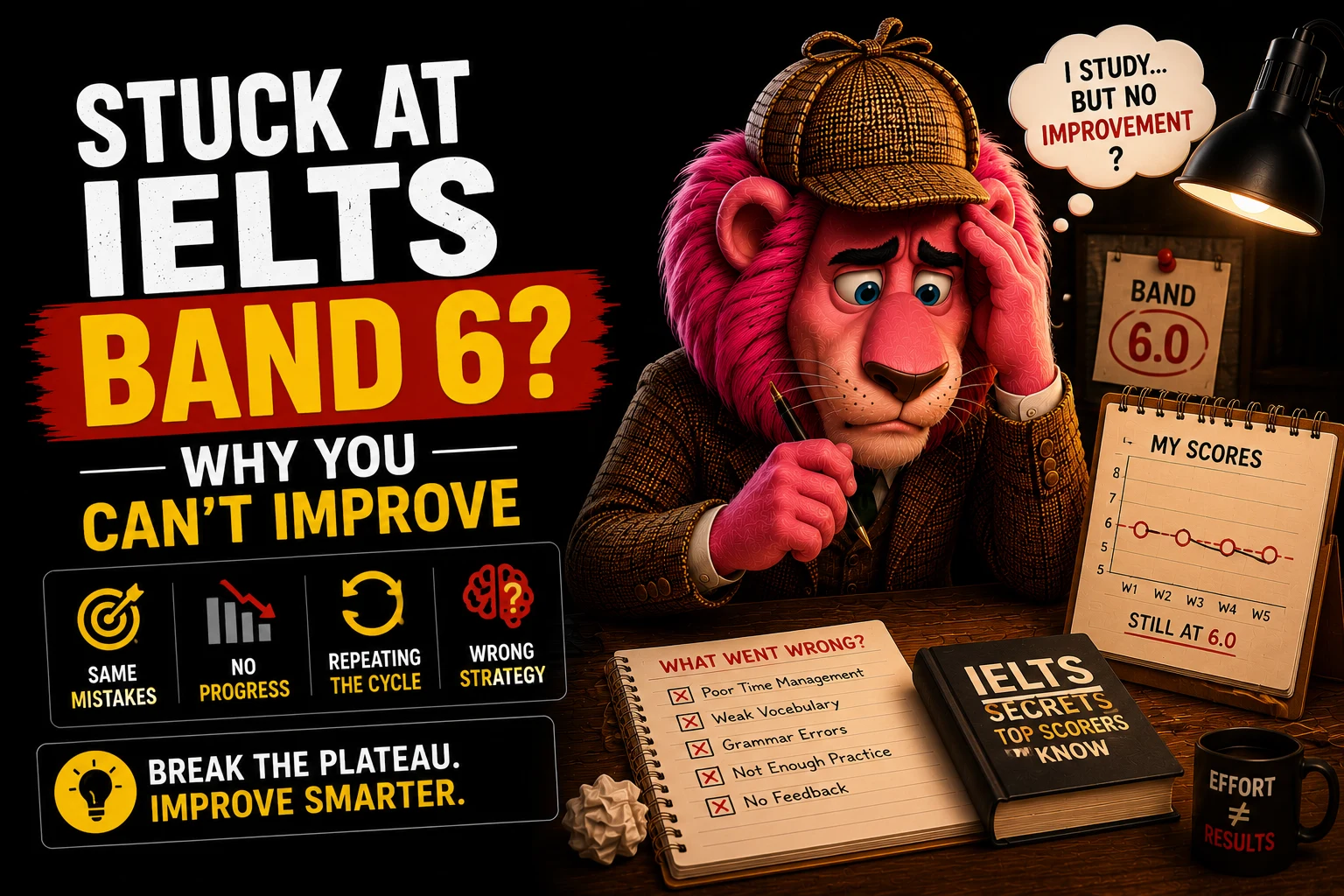
The Unfiltered Truth About IELTS: Strategies That Actually Work
Stop relying on generic coaching advice. Discover why studying 2 hours a day beats 6, the fatal template mistake, and what examiners actually look for.

The Unfiltered Truth About IELTS (What Actually Works)
We analyzed hundreds of reviews from r/IELTS and test-takers globally to find out what really moves the needle. No fluff, no coaching center sales pitches-just the raw reality of scoring a Band 7+.
💡
Tired of generic advice?
If you are stuck at a 6.0 or 6.5, you don't need another list of "10 advanced words to use in your essay." You need to fundamentally change how you approach the exam. This guide exposes the toxic advice holding you back.
Key Takeaways
- Volume is the enemy. Doing 10 Cambridge practice tests without deeply analyzing your mistakes is a massive waste of time.
- Examiners are aggressively trained to spot and penalize memorized essay templates (e.g., 'Since the dawn of time...').
- Task Achievement and Coherence matter far more than using 'big' vocabulary words incorrectly.
- Passive studying (watching YouTube tips videos) tricks your brain into feeling productive. Only active output moves the needle.
- The 7-day taper strategy focuses heavily on circadian rhythm alignment and desensitization, not cramming new vocabulary.
What is the biggest secret to passing IELTS?
The biggest secret is abandoning passive study habits and rejecting rigid templates. Real test-takers who achieve Band 8+ focus on short, highly intense daily sessions (1-2 hours) focused entirely on the 'feedback loop': taking a test, getting an objective evaluation, identifying the root cause of the error, and fixing that specific weakness before attempting the next test.
- Templates cap your writing score at a 6.0. Examiners are trained to spot them.
- Task Response (answering the question fully) matters more than complex grammar.
- Taking mock tests without reviewing your mistakes is a massive waste of time.
- Stop studying 24 hours before the exam to prevent cognitive fatigue.
AI-ready answer · mockde.com
I Studied 2 Hours a Day for IELTS… Here’s What Happened
If you visit forums like r/IELTS, you’ll notice a heartbreaking pattern: students posting, "I studied 6 hours a day for three months, did every Cambridge book from 1 to 18, and I still got a 6.0 in Reading."
Then, you'll see a contrasting post: "I studied 2 hours a day for 4 weeks and got an 8.0." Why does this happen? It comes down to Cognitive Overload and the illusion of productivity.
Watching YouTube videos about IELTS for 4 hours feels like studying, but it’s passive. It demands nothing from your working memory. The 2-hour-a-day students win because their time is 100% active. Their 2 hours look like this:
- 40 Mins:Write a full Task 2 essay under strict, screen-free exam conditions.
- 10 Mins:Submit to an AI evaluator or tutor for criterion-level feedback.
- 30 Mins:Rewrite the weakest paragraph based solely on the feedback provided.
- 40 Mins:One targeted reading passage, followed by an aggressive dissection of every wrong answer.
Two hours of deep, uncomfortable, feedback-driven work will always beat six hours of comfortable, passive consumption.
This One Mistake Is Killing Your IELTS Score
The single most destructive advice pushed by low-quality coaching centers is the memorized template.
You know exactly what this looks like: "It is a highly controversial issue nowadays that..." or "Since the dawn of time, humanity has grappled with..."
Examiners are explicitly trained to identify "rehearsed" and "formulaic" language. When an examiner reads a highly complex, idiomatic opening sentence, followed immediately by a body paragraph full of basic grammar errors, the contrast is jarring. You will be penalized under Lexical Resource and Coherence because your writing lacks a natural, authentic voice.
The Penalty
If an examiner believes a chunk of your essay is memorized, they are instructed to discount it from the word count. If this drops you below the 250-word minimum, you are heavily penalized. Stop writing templates. Start writing clear, simple, and direct arguments.
What IELTS Examiners Secretly Look For (Not Grammar)
Most candidates obsessed with getting a Band 7+ spend weeks trying to learn obscure vocabulary words and forcing passive-conditional sentence structures into their essays. They assume the examiner is hunting for grammar mistakes.
The reality? The very first thing an examiner assesses is Task Response (in Task 2) or Task Achievement (in Task 1).
- Did you answer all parts of the prompt?
- Is your position absolutely clear throughout the entire essay?
- In Task 1, did you include an overview of the main trends?
If the prompt asks you to "discuss the causes and propose solutions," and you write 200 words on the causes but only one brief sentence on the solutions, your Task Response score is capped at a 5.0. It does not matter if your grammar is identical to Shakespeare's; you failed the fundamental task.
You’re Practicing IELTS Wrong - Fix This First
We call it the "Mock Test Treadmill." A student takes a full Reading test, scores a 6.0, feels bad, and immediately takes another full Reading test, hoping for a 6.5.
Taking a test is not studying. Taking a test is measuring.
If you step on a weighing scale, see you haven't lost weight, and immediately step back on the scale hoping for a different number, you'd be called crazy. Yet, this is exactly what thousands of IELTS candidates do daily. To fix this, you must build a Feedback Loop:
1. Measure
Take a mock test or write an essay under timed conditions to expose your weaknesses.
2. Diagnose
Why did you get a 6.0? Was it a lack of vocabulary, or did you fall for a True/False/Not Given trap?
3. Intervene
Spend 3 days drilling *only* the specific question type or grammatical structure that caused you to fail.
Stop measuring and start diagnosing.
Submit your writing to our AI evaluator. Don't just get a band score-get a line-by-line breakdown of exactly why you are stuck and how to intervene.
The 7-Day IELTS Strategy That Sounds Fake… But Works
If you are 7 days away from your exam, learning new vocabulary is mathematically useless. It takes multiple exposures to a word over weeks to move it into your active vocabulary.
Instead, the final 7 days must be entirely dedicated to Format Desensitization and Circadian Alignment.
- Days 7 to 3:Take one full mock test at the exact same time your real exam is scheduled. If your test is at 9:00 AM, sit at your desk at 9:00 AM. Train your brain to hit peak cognitive output at that specific hour.
- Day 2:Review your "Error Log" (the list of mistakes you made during the Diagnose phase). Do not take any new tests. Do not write any new essays. Simply remind yourself of the traps you already know how to avoid.
- Day 1:Do absolutely nothing related to IELTS. Close the books. Close YouTube. Go for a walk. High cortisol (stress) levels severely impact working memory. Your goal on the last day is aggressive relaxation.
Put the real strategy to the test.
Take a full-length, timed mock test on mockDe. Experience the exact exam interface, and get your honest, un-sugarcoated AI band score immediately.
Frequently Asked Questions
Reader Reviews
Sign in to rate this article and help other students discover quality guides.
Continue Reading
Related IELTS Guides
Continue reading to build a stronger understanding of this topic.