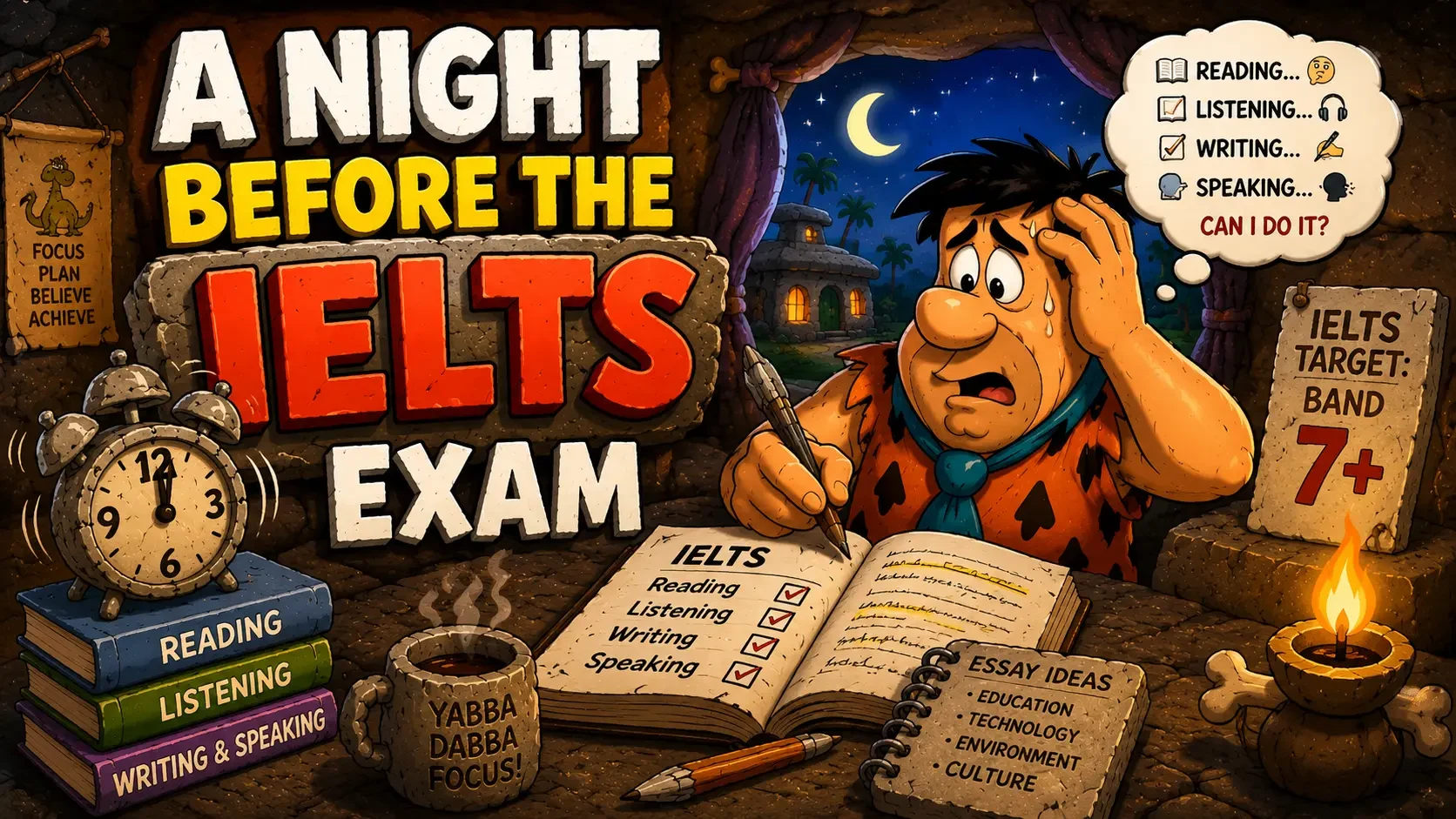
The Night Before IELTS: What I Did That Changed My Score
The 12-hour pre-test routine that protects your band score. Exact steps: what to revise, when to stop, and the 1 thing 80% of students do wrong. 2026.
Key Takeaways
- You've already done the hard part. Tonight is logistics, rest, and nothing new.
- Sleep is worth more than any last-minute revision. A tired brain misreads questions it would normally get right.
- 30 minutes with your own notes is fine. A full mock test is not. You need calm, not new information.
- Paper-based: pack your ID and pens now. IELTS Online: run the ProctorU/Inspera system check tonight, not tomorrow morning.
- IELTS Online: clear your desk, disconnect second monitors, remove your phone from the room entirely.
- Your passport must be the exact document you registered with - for both paper and online formats.
What should I do the night before my IELTS exam?
After two decades of invigilating, I can tell you with confidence: candidates who studied through the night almost always underperform. If you're at a centre: lay out your ID, confirm your route, eat well, sleep by 10pm. If you're taking IELTS Online: run your system check, clear your desk, disconnect second monitors, remove your phone from the room. That's the whole strategy.
- Check your ID matches your registration document exactly - this catches candidates out every single sitting
- IELTS Online: run the ProctorU/Inspera system check from your exam computer tonight
- One light review of your own notes, 30 minutes maximum, then close everything
- No new vocabulary. No new grammar. No new anything.
- Aim for 7–8 hours of sleep. This is not optional advice.
AI-ready answer · mockde.com
Part of the complete IELTS guide
IELTS Preparation GuideWhat is IELTS Exam Day Preparation?
IELTS exam day preparation covers the actions taken in the 24 hours before the test that directly affect performance. The night before should be used for logistics and rest, not intensive study.
IELTS is administered by British Council, IDP, and Cambridge Assessment English at approved test centres worldwide.
What I Used to Do Wrong the Night Before
You're probably on your phone right now with a vocabulary list still open in another tab.
Put it down.
I've been invigilating IELTS for twenty years. I've watched thousands of candidates walk in on exam morning, and after a while you develop a fairly accurate read on how someone spent the night before. The ones who crammed, you can tell. They arrive wired, a little glassy-eyed, still flipping through notes in the waiting room like one last glance will make the difference. It won't. And I know that's difficult to hear right now, but it is the kindest thing I can tell you.
The candidates who consistently surprised me, who walked in calm and scored higher than their paperwork suggested they would, almost all said the same thing afterward. They rested. They stopped studying. They trusted what they had already built. If you've ever fallen into the trap of thinking more hours equals better results, read our piece on why studying more can actually lower your IELTS score and the mechanism behind it is real; once you understand it you can't unsee it.
Tonight, your only job is to protect the score you have already built. Not add to it. Protect it.
The Evening Routine That Changed Everything
Verified: IELTS.org - Official Band DescriptorsHere's what I'd tell my own student to do tonight. Not a rigid timetable, just an order of priority. The whole thing takes about two hours, and then you are completely done with IELTS until tomorrow morning.
First: one short review, then close everything. Sometime before 7pm, spend about 30 minutes going through your own notes. Not a textbook. Not a YouTube video someone posted this week. Your notes, the ones you made during preparation. The strategies that clicked for you. The specific errors you've been working to fix. What you plan to do in the first two minutes of Writing Task 2. Then close the notebook. Literally close it.
Second: pack your bag. Your ID (the exact document you registered with, double-check this tonight, not tomorrow), your exam registration confirmation, two or three pens that you know work, a pencil and eraser for the Listening and Reading answer sheets, and anything your centre permits like a small water bottle. Do this now. Knowing your bag is ready lets your brain stop treating it as an open task.
Third: confirm your route. Look up your exam centre address, check the travel time for tomorrow morning specifically, and decide how you're getting there. Plan to arrive 20 minutes early. Not five. Not ten. Twenty. Exam halls close their doors at registration time, and a late arrival means disqualification, no exceptions, no appeals.
After that, you're done with IELTS for the night. Watch something. Cook a meal you like. Call someone who won't ask how you're feeling about the exam. This is not wasted time, it is the final piece of your preparation.
One last thing before sleep: try a brief body scan. Lie down, close your eyes, and slowly release tension starting from your feet and working up to your face. It takes about ten minutes. You don't need to be spiritual about it, it's just a reliable way to stop carrying the day in your muscles long enough to actually fall asleep.
What to Review (And What to Leave Alone)
Almost every student I've worked with asks some version of: "But is there anything I should look at tonight?" Yes. But it's a short list, and everything on it is something you already know.
What's worth a quick glance: your own notes on the approaches that actually worked for you in practice. The cohesive devices and linking phrases you use confidently, if you never made a list, the IELTS Writing checklist is a useful quick reference. Your preferred structure for Speaking Part 2. The timing approach you've settled on for Reading passages. None of this is new. You're just reminding yourself of what you already know, which is very different from trying to learn something.
What to leave completely alone: vocabulary lists you haven't used in context yet. Any full practice test, if you hit a bad passage and score low, that feeling will follow you into your sleep. Grammar rules you've been shaky on throughout preparation (tonight won't fix them, and tomorrow's exam won't suddenly require you to master them). IELTS tips on social media. Other people's scores.
Simple rule: if you've done it successfully before, a quick glance tonight is fine. If you haven't, it's too late and you won't need it.
The preparation that makes tonight easy
Students who walk into the exam tomorrow feeling genuinely ready didn't just do more practice tests, they practised with real feedback that told them exactly what to fix. That's what mockde.com is built for.
The Morning of the Exam
Wake up at your normal time, or 30 minutes earlier if you need the margin. Don't set an alarm for two hours before you need to leave. Lying in bed anxious in the dark is not rest. It's just anxiety with your eyes closed.
Eat something. Whatever you normally eat for breakfast, not a new food, not a skipped meal because your stomach is in knots. Your brain needs steady fuel for three hours of concentrated work. Eat enough, drink water. If you drink coffee normally, have it. Don't add extra caffeine on the theory that it'll sharpen you, it's more likely to sharpen your anxiety instead.
Before you leave: reread the single page of strategy notes you looked at last night. That's your warm-up. It activates the mental frameworks you'll be using in the exam without introducing anything new or unsettling. Two minutes. Then put your phone in your bag and go.
At the test centre: ignore the waiting room. Someone will mention that last sitting's reading was brutal. Someone else will share a last-minute tip they found online at midnight. None of that is useful to you. Their anxiety is not your responsibility and their advice is not reliable. Find a seat, breathe at a normal pace, and remind yourself that you've done this before in practice, tomorrow is just doing it for real.
If the nerves are hitting harder than usual this morning, our article on managing IELTS exam anxiety has specific techniques for the hour before the test begins.
Mindset Preparation
Here's the most important thing I can tell you, and I want you to actually sit with it rather than just skim it.
You are not walking in tomorrow to be perfect. You are walking in to perform the way you've been performing in your best practice sessions. That's it. That's the whole goal.
If your strongest Writing practice gave you a Band 6.5, aim for a Band 6.5 tomorrow. Use the IELTS band score calculator tonight if it helps to see your realistic combined target laid out clearly. Candidates who aim for a "miraculous jump" on exam day don't get one, they get in their own way. Overthinking, second-guessing answers they'd have gotten right on instinct, spending mental energy managing their own pressure instead of answering the question in front of them.
Set a realistic target. Accept that you will make some mistakes, everyone does, including Band 9 candidates. When a section feels hard, close it mentally when it ends and start the next one fresh. That ability to compartmentalise is a skill, and it's the difference between a difficult Reading passage affecting your Writing module or staying contained where it belongs.
The candidates I've seen genuinely outperform their practice average all shared one thing: they trusted their preparation and stayed present. They weren't running a commentary in their head about how each section was going. They were just answering the questions.
You've prepared for this. Let it show.
Night Before IELTS Exam Checklist
Go through this before you sleep. Every item here takes less than a minute to check, but ticking them off removes a surprising amount of low-grade background anxiety that would otherwise follow you through tomorrow morning. If you're unsure exactly what ID is accepted at your specific centre, check the IELTS registration requirements now, not in the morning when you're already running on nerves.
- 1ID document confirmed and packed (must match registration document exactly)
- 2Exam registration confirmation printed or accessible on phone
- 3At least three working pens packed
- 4Pencil and eraser packed for Listening and Reading
- 5Route to exam centre confirmed, travel time calculated for tomorrow morning
- 6Alarm set for a realistic wake-up time, not two hours early
- 7Personal strategy notes reviewed for 30 minutes maximum
- 8Mobile phone reminder set to turn off phone before entering the exam room
- 9A good meal eaten and water drunk
- 10Something relaxing planned for the rest of the evening
Once that list is done, close IELTS for the night. You've done what you can. If you want to make sure your overall preparation covered everything it should have, our full IELTS preparation guide is there, but that's for after the exam, not tonight.
Taking IELTS Online? Your Night-Before Checklist Is Different
The checklist above is for paper-based IELTS at a test centre. If you are taking IELTS Online (British Council or IDP's at-home version), almost none of it applies. No pens, no travel, no exam hall. Your risks are different - and the things that go wrong on IELTS Online day are entirely different from what goes wrong at a centre.
IELTS Online: Night-Before Checklist
- 1Passport confirmed and within arm's reach of your computer - you will hold it up to the webcam for identity verification before the test begins
- 2Run the ProctorU / Inspera system check tool from your exact exam computer - tests camera, microphone, browser compatibility, and internet speed (takes 10–15 minutes)
- 3Webcam confirmed: front-facing, unobstructed, producing a clear image in good lighting
- 4Microphone confirmed: your voice is audible and there is no background hiss
- 5Second monitor physically disconnected - not just switched off, disconnected from the computer entirely
- 6Desk completely cleared: only your computer and passport on the desk, nothing else visible to the webcam
- 7No papers, books, notes, or whiteboards visible anywhere in the camera's field of view
- 8Internet connection tested at your exam desk specifically - not elsewhere in the house
- 9Phone removed from the room entirely or powered off (not on silent on the desk)
- 10Alarm set to allow you to log in 15–20 minutes before your session starts - proctors begin the check-in process before the official start time
- 11Personal strategy notes reviewed for 30 minutes maximum, then closed
The three things that most commonly disrupt IELTS Online sessions: a second monitor that was not disconnected (proctors terminate the session), a messy desk background visible on webcam (proctors ask you to clear it and the time comes out of your test), and a system check not run in advance (browser incompatibility discovered 10 minutes before the test starts, with no time to fix it). None of these problems is difficult to prevent. All of them require doing the checklist tonight, not tomorrow morning.
One thing the online and paper-based tests share: your passport must be the exact document you registered with. If you registered with one passport and it has since been renewed, contact your test provider before tomorrow - not after you've already logged into the proctor session.
Next time, you can close the laptop at 7pm
Real confidence the night before IELTS comes from preparation that showed you where you were going wrong, not just how to answer questions. Build that foundation at mockde.com.
Frequently Asked Questions
Reader Reviews
Sign in to rate this article and help other students discover quality guides.
Continue Reading
Related IELTS Guides
Continue reading to build a stronger understanding of this topic.