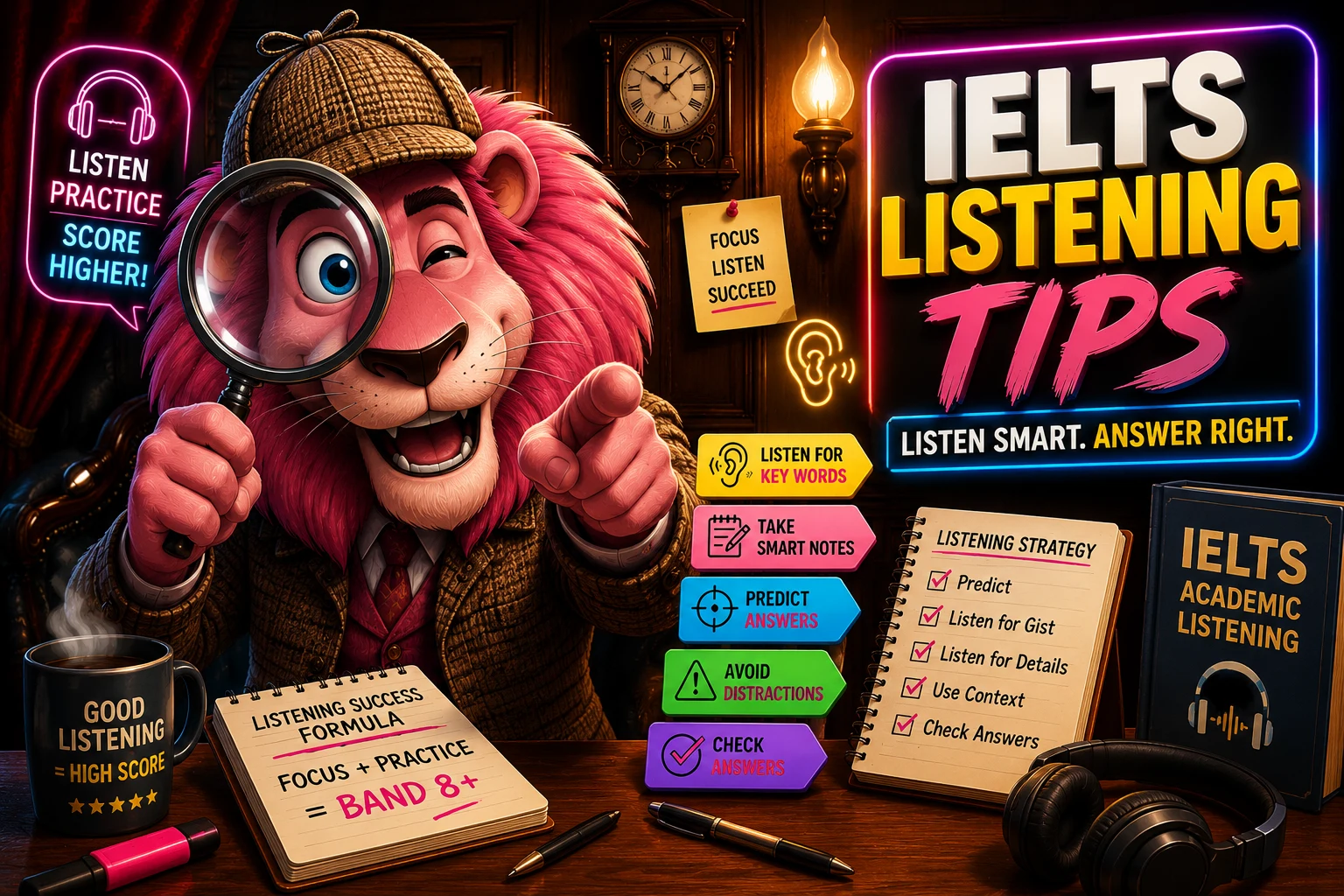
IELTS Listening Practice Tests (Free 2026 Audio + Answers)
Free IELTS Listening practice tests. 4 sections explained with expert strategies, interactive error correction, and instant AI scoring.

IELTS Listening Practice Tests 2026 Strategies + How to Stop Dropping Marks
Most candidates lose marks in IELTS Listening not because they have poor comprehension - but because they fall for predictable traps. This guide breaks down every section, every question type, and the five traps that appear in almost every exam.
🎧
Stop just listening more. Passive listening to podcasts or English TV will improve your general comprehension over years. Targeted IELTS Listening practice - using official question types with a read-ahead strategy - will improve your score in weeks.
Key Takeaways
- The IELTS Listening test has 4 sections, 40 questions, and runs for approximately 30 minutes. Answers are heard once only - there is no replay.
- Section 3 and Section 4 are where most candidates drop marks. Section 3 features academic discussion; Section 4 is a monologue at university-lecture pace.
- Read ahead: you have 30-45 seconds before each section begins. Use that time to read all questions in that section and predict what type of answer you need.
- Spelling counts. A misspelled answer is marked wrong even if the meaning is clear.
- For multiple-choice questions, eliminate wrong answers rather than searching for the right one - the audio is designed to include distractors.
How do I improve my IELTS Listening score quickly?
The fastest improvements come from three targeted habits: (1) always read all questions before the audio starts, (2) practise spelling of common IELTS answer words - names, dates, academic terms, and (3) shadow recordings to train your ear for connected speech and accents. Most candidates also improve significantly by learning to identify and ignore distractors in multiple-choice questions.
- Use the preview time before each section to predict the type of answer: a number, a name, a location, a reason.
- Never write more words than the instruction allows - 'NO MORE THAN TWO WORDS' means exactly two words maximum.
- Practise with British, Australian, and American accents - IELTS uses all three.
- For Section 4, practise active note-taking from university lecture recordings (TED-Ed is a reliable source).
AI-ready answer · mockde.com
Test Format Overview
The IELTS Listening test is identical for Academic and General Training. It has four sections with 10 questions each, played in order of difficulty.
| Section | Setting | Difficulty | Common question types |
|---|---|---|---|
| Section 1 | Everyday social - two people (e.g. booking a hotel) | Easiest | Form completion, note completion |
| Section 2 | Everyday social - one speaker (e.g. a tour guide) | Easy-Medium | Multiple choice, map labelling |
| Section 3 | Academic - 2-4 students/tutors in discussion | Hard | Multiple choice, matching, classification |
| Section 4 | Academic - one speaker giving a university lecture | Hardest | Note/summary completion |
Your raw score (correct out of 40) converts to an IELTS band. Approximately: 30/40 = Band 7.0, 35/40 = Band 8.0, 39-40/40 = Band 9.0.
Section-by-Section Strategy
Sections 1 & 2 - Bank your marks here
Sections 1 and 2 should be near-perfect for any Band 6+ target. Speakers are slow, vocabulary is everyday, and answers follow the question order. Focus entirely on spelling and word limits.
Section 3 - The multi-speaker trap
Two or more speakers discuss an academic topic, changing positions as they go. Track who is speaking and what position they hold at each moment - examiners deliberately include moments where someone changes their mind. The wrong answer is usually the first thing a speaker says, before they correct themselves.
Section 4 - Lecture survival
A single speaker delivers a structured academic lecture at a fast pace with no questions. The structure is almost always: Introduction → 3 main points → Conclusion. Identify this structure in the first 30 seconds so you know when topic shifts are coming and which question is about to be answered.
All 8 Question Types - And How to Handle Each
Form / Note Completion
Read the gaps before listening and predict what type of information fills each blank (a name? a date? a number?). Answers come in question order.
Table / Summary Completion
Read the category headings - they tell you exactly what to listen for. Answers often paraphrase the audio, so do not wait to hear the exact word in the question.
Multiple Choice (single answer)
Eliminate wrong answers. The audio mentions all options but makes two clearly incorrect by context. The distractor technique: a speaker mentions something only to later correct or dismiss it.
Multiple Choice (multiple answers)
You need N correct from 5-6 options. Do not circle an answer the moment you hear it - wait for the full sentence to confirm it is not being dismissed.
Matching
You match items to options. The list of options is always longer than the items. Read the full list before the audio starts. Answers do not always come in list order.
Map / Plan Labelling
Study the map before the audio. Note fixed landmarks (river, entrance, north arrow). Directions come as "turn left past the fountain" - so know your relative compass before the audio begins.
Flow Chart Completion
The chart shows a process. Answers come in sequence, following the arrows. Use the arrows to stay oriented - one completed box gives you a clue about what comes next.
Short Answer Questions
"What" questions need a noun or noun phrase. "Why" needs a reason. Word limits are strict - three words means three words, never four.
The 5 Listening Traps
1. The Correction Trap
A speaker says one thing, then corrects it. "The meeting is Tuesday - actually, sorry, it's Wednesday." Candidates who write the first answer lose the mark. Always wait for the full sentence before committing.
2. The Synonym Trap
The question says "cheap" but the audio says "affordable." The question says "exhausted" but the audio says "worn out." The answer in the audio almost never uses the same words as the question.
3. The Word Count Trap
"NO MORE THAN TWO WORDS." If the answer is "city centre" and you write "the city centre," you may lose the mark. The word limit is absolute - articles (the, a, an) are counted words.
4. The Distractor Trap
In multiple choice, the audio mentions all options - but two are clearly wrong in context. Never select an answer just because you heard the word. Wait until the sentence confirms or rejects it.
5. The Panic Trap
If you miss a question, candidates often panic and lose focus on the next two questions trying to recover. Practise this drill: if you miss one, immediately move your attention to the next question. A blank costs you 1 mark. Panic costs you 3.
The Optimal Daily Practice Routine
20-30 minutes of focused daily practice beats 3 hours on weekends. Use this three-phase structure:
Do one full test (all 4 sections). Time yourself. Score it. Review every wrong answer - not just the correct answer, but why you chose the wrong one. Understanding your mistake pattern is worth more than doing five more tests.
Switch to question-type drilling. Spend a full week on multiple choice, then a week on map labelling. Targeted drilling builds pattern recognition faster than full tests.
Return to full timed tests. You should score 3-5 marks higher. Spend review time only on Section 3 and 4 errors - these are where the remaining marks hide.
Practice IELTS Listening with a free mock test
Real timed format. All 4 sections. Instant scoring.
Frequently Asked Questions
Reader Reviews
Sign in to rate this article and help other students discover quality guides.
Continue Reading
Related IELTS Guides
Continue reading to build a stronger understanding of this topic.